Paul Dukas
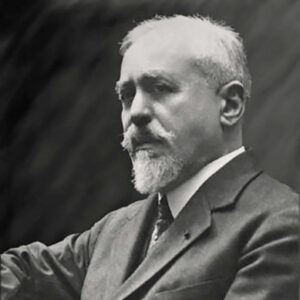
Paul Dukas places exacting standards at the heart of his art. Born in Paris in 1865, he left a deliberately small catalogue after discarding many of his compositions. This rigor, combined with a remarkable mastery of orchestral technique, gives each of his works a singular presence.
Trained at the Conservatoire de Paris with Théodore Dubois and Ernest Guiraud, he won the second Grand Prix de Rome in 1888 with the cantata Velléda. The Sorcerer’s Apprentice, a symphonic poem inspired by Goethe and composed in 1897, brought him lasting fame. His output also includes the Symphony in C, the opera Ariane and Bluebeard, premiered in 1907 to a libretto by Maurice Maeterlinck, and the danced poem La Péri.
Composer, music critic and pedagogue, Dukas first taught orchestration then composition at the Conservatoire. Olivier Messiaen and Maurice Duruflé were among his students. He died in Paris in 1935 and remains a distinctive figure in French music: a creator attentive to form, colour and the precision of musical gesture.