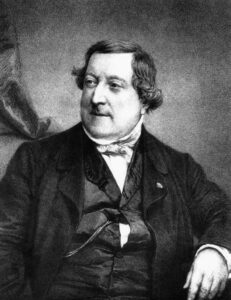
Gioachino Rossini (1792 – 1868)
With Gioachino Rossini, the orchestra gives the theatre its breath: the drive of ensembles, the art of acceleration and the clarity of melodies carry both laughter and feeling. Born in Pesaro on 29 February 1792 into a family of musicians, he studied in Bologna and had his first opera, La cambiale di matrimonio, staged in Venice in 1810.
His Italian career took him notably to Naples, where he composed both serious works and comedies. The Barber of Seville (1816) and La Cenerentola (1817) showcase his sense of comedy, while Tancredi and Mosè in Egitto reveal another facet of his dramatic art. Settled in Paris from 1824, he composed Le Comte Ory and then William Tell in 1829, his last opera.
Rossini then continued to write, including the Stabat Mater, completed in 1842, and the Petite Messe solennelle of 1863. He died in Passy in 1868, leaving a body of work in which vocal virtuosity, theatrical precision and rhythmic invention remain inseparable.