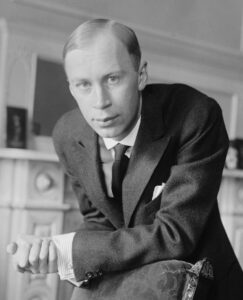
Sergei Prokofiev (1891 – 1953)
In Sergei Prokofiev, rhythmic drive, irony and lyricism answer one another with an immediately recognisable freedom. Born in 1891 in Sontsovka, in what is now Ukraine, he grew up with a pianist mother who encouraged his musical gifts. At the Saint Petersburg Conservatory, where he studied from 1904 to 1914, he received the Anton Rubinstein prize for his piano playing.
A composer and pianist, Prokofiev worked in symphony, concerto, opera, ballet and film music. After leaving Russia in 1918 he pursued an international career before returning to the Soviet Union in the 1930s. His music combines clarity of form, striking contrasts and a taste for the theatrical.
The Classical Symphony, Romeo and Juliet and Peter and the Wolf, conceived to introduce instruments to children, are among his best-known works. Condemned along with other composers for “formalism” in 1948, he nevertheless continued to create. He died in Moscow on 5 March 1953, leaving a body of work that still surprises by its energy and invention.