Orchestre de la Suisse Romande
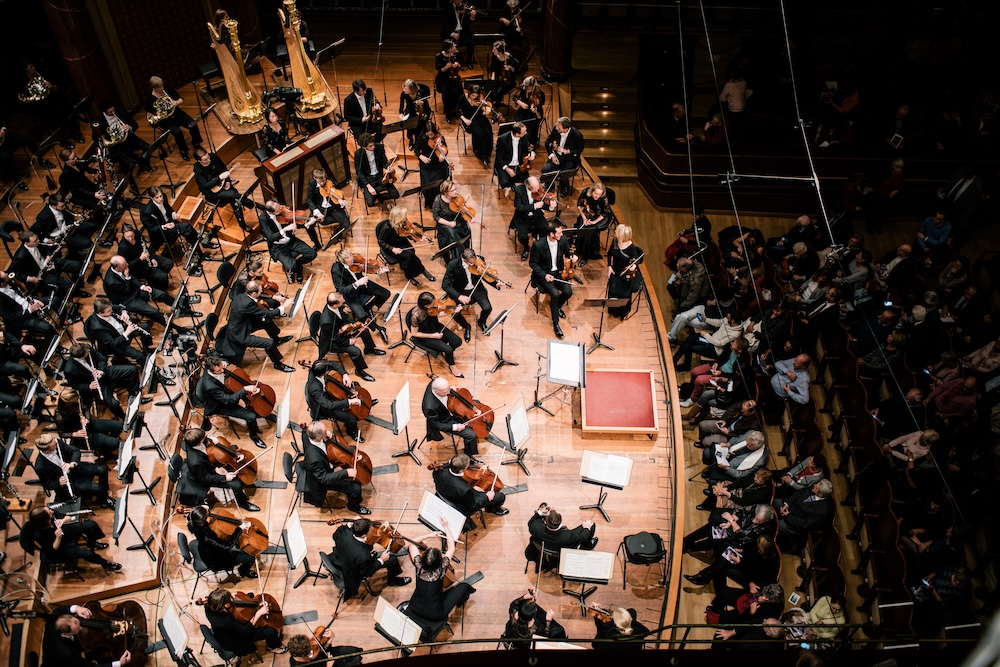
Since 1918, the Orchestre de la Suisse Romande has been showcasing the music of Geneva and Lausanne on major international stages. Its 112 permanent musicians champion the masterpieces of the repertoire, bring new scores to life, and tirelessly strive to bring the orchestra closer to its audience. Radio, recordings, and then immersive experiences further a single ambition: to share the emotion of the concert without ever losing sight of the people who create it.
Ernest Ansermet: a beginning focused on creation
In 1918, Ernest Ansermet founded the OSR and led it for nearly half a century. His experience with the Ballets Russes and his closeness to the composers of his time helped shape the orchestra’s identity. The French and Russian music of the 20th century found pride of place there, alongside the classics, opera, and contemporary works.
In Geneva, the OSR notably premiered works by Frank Martin, Arthur Honegger, Benjamin Britten, Heinz Holliger, and Pascal Dusapin. This curiosity is not merely a matter of history: supporting creation, particularly Swiss creation, remains one of its missions. At Victoria Hall as in Lausanne, at the Grand Théâtre de Genève, in schools or during open rehearsals, the orchestra brings music to audiences of different generations. Its tours also take it to Europe, Asia, and the Americas.
Conductors who shaped a sound
Ansermet led the orchestra from 1918 to 1967. Paul Klecki succeeded him from 1967 to 1970, followed by Wolfgang Sawallisch (1970–1980), Horst Stein (1980–1985), Armin Jordan (1985–1997), Fabio Luisi (1997–2002), Pinchas Steinberg (2002–2005), Marek Janowski (2005–2012), Neeme Järvi (2012–2015) and Jonathan Nott (2017–2025). Each opened up new horizons for an ensemble that, across eras, has retained a taste for collective work and musical encounters.
Kazuki Yamada also brought his perspective as principal guest conductor from 2012 to 2017. Beginning with the 2026–2027 season, Tugan Sokhiev will join the OSR as principal conductor and artistic adviser. This succession of artists tells less a story of ruptures than an ongoing conversation, carried from generation to generation between the musicians, their conductors, and the works.
From radio to the first steps of stereophony
Very early on, collaboration with Swiss radio and television allowed concerts to go beyond the walls of the hall. The recording partnership with Decca — more than one hundred discs — carried the OSR’s sound well beyond Switzerland. These recordings introduced listeners around the world to an orchestra particularly attentive to the colors and balances of music.
In 1954, Ansermet and the OSR recorded Antar by Rimsky-Korsakov during Decca’s first stereophonic trials. This pioneering milestone in the label’s history heralded an idea that spans the decades: a capture innovation makes full sense when it allows music to be heard with new intensity. A Decca box set of 88 CDs released in 2023 brought this recording tradition back into the spotlight.
icologram®: making the orchestra visible differently
Since 2019, the Swiss company Cybel’Art has been developing icologram®, a capture and rendering technology designed to open up new forms of stage presence. In September 2023, the OSR was captured at the Théâtre de Beaulieu in Lausanne. The gestures of the players, their glances and their way of making music together become the material for an experience conceived with them.
At Art Genève, from 25 to 28 January 2024, 73 musicians appeared in Pictures at an Exhibition by Mussorgsky, orchestrated by Ravel, under the direction of Ana María Patiño-Osorio. For the OSR, the aim is not to replace the live concert, but to bring the orchestra where it cannot perform and to spark the curiosity of new audiences.
Virtual Hall: at the heart of music
The OSR is behind Virtual Hall, presented at Art Genève in January 2025 and developed with Cybel’Art. The orchestra carries the musical vision and brings the artists together; its partner designs the immersive application. Their collaboration gives rise to a new way of discovering the symphonic performance, true to the spirit of sharing that has animated the OSR since its beginnings.
Thanks to concerts captured in 360 degrees at Victoria Hall, the audience can choose its point of view through a virtual reality headset and follow a synchronized score. You can move closer to the music stands, watch the conductor facing the musicians, and discover how an interpretation is built from the inside. Beethoven’s Third Symphony and the overture to William Tell by Rossini are among the works on offer: two invitations to listen differently to familiar pieces.
Since 26 September 2026, two Virtual Hall headsets have been made available free of charge at the Bibliothèque de la Cité de Genève. This presence in a place of reading and discovery extends the school concerts, radio, tours, and encounters with the orchestra. From stereophony to icologram®, then to Virtual Hall, the OSR thus charts a coherent path: putting new techniques at the service of music, of artists, and of all who wish to meet them.